Wunfu Elementary School: Green Mobility in the City — A Plastic-Reduction Guide Built by Students
High-quality low-carbon travel content, created by a group of elementary school students! The site brings together five student-designed routes, must-see stops, and a bilingual map of plastic-reduction-friendly businesses — blending local history and culture to turn classroom action into a public-facing digital platform.
Travel video platform
Five low-carbon routes, fully presented in video
Interactive map
38 plastic-reduction-friendly businesses listed in Chinese and English
Easy to maintain
Clean data design supports Excel import
Requirements
To promote plastic-reduction education and low-carbon city travel, students carefully designed local travel routes — surveying their community, visiting plastic-reduction-friendly businesses, and planning public-transit itineraries. The school wanted a complete digital website so these efforts could reach a wider audience, along with a plastic-reduction-friendly business map the school could keep updated over time.
- The coursework produced a wealth of material — route plans, business-visit records, video content — but it was scattered across different media with no unified digital front door for the public
- Plastic-reduction-friendly business data needs ongoing long-term maintenance, so the site had to flexibly accommodate changes as that data evolved
- The site's audience includes international partner schools, so it needed bilingual Chinese-English presentation, with a visual style matching the lively, playful tone of the students' work
Let's Solve It!
- Adopted a Vue.js + Nuxt.js + Vuetify front-end framework with responsive (RWD) design, ensuring a consistent browsing experience across every device
- Integrated YouTube video embeds, student-shot photos, and route/attraction information, so every route comes with complete digital guide content
- Designed a bilingual Chinese-English plastic-reduction-friendly business map, with a back-office data update mechanism so business information can be adjusted directly whenever it changes
- Deployed on a Google Cloud Platform server in Taiwan, reliably handling traffic demands during the campaign's promotional period
Case Details
Letting the world see what students discovered
The students of Wunfu Elementary School did something remarkable: they measured Kaohsiung on foot, then set out to document everything beautiful about their city.
This is sustainability education at its best. Students didn’t just learn it in the classroom — they actually went out into the community. They planned low-carbon city routes using public transit, visited local plastic-reduction businesses, produced video documentation, and held briefing sessions. These efforts added up to five concrete travel routes and a list of plastic-reduction-friendly businesses — scattered across paper documents, group chats, and YouTube. All that was missing was one complete platform to bring it all together online.
Image source: 5A TRAVEL 旅城‧綠動Go on
Five routes, five faces of one city
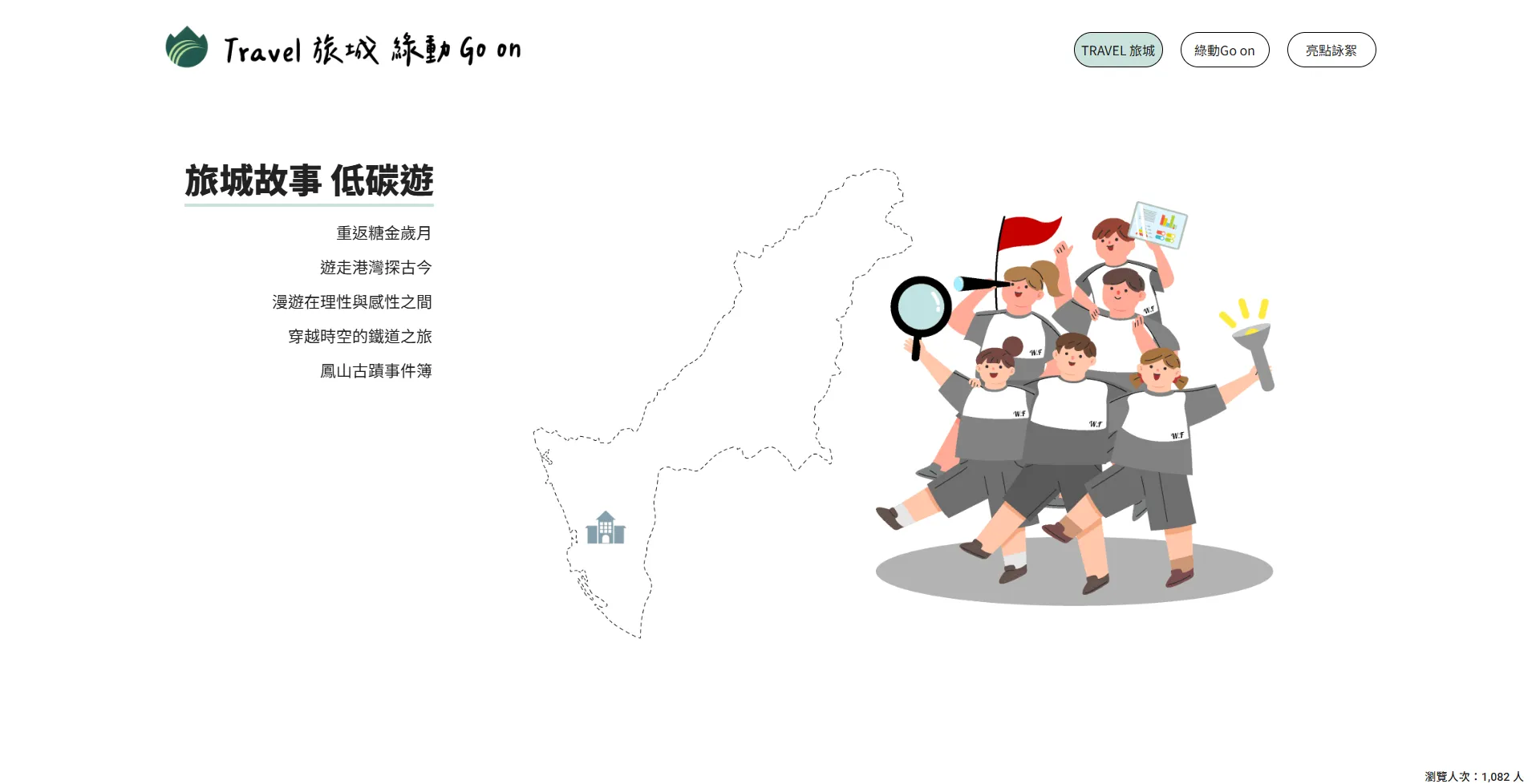
The five low-carbon city travel routes the students designed by hand are the heart of this website:
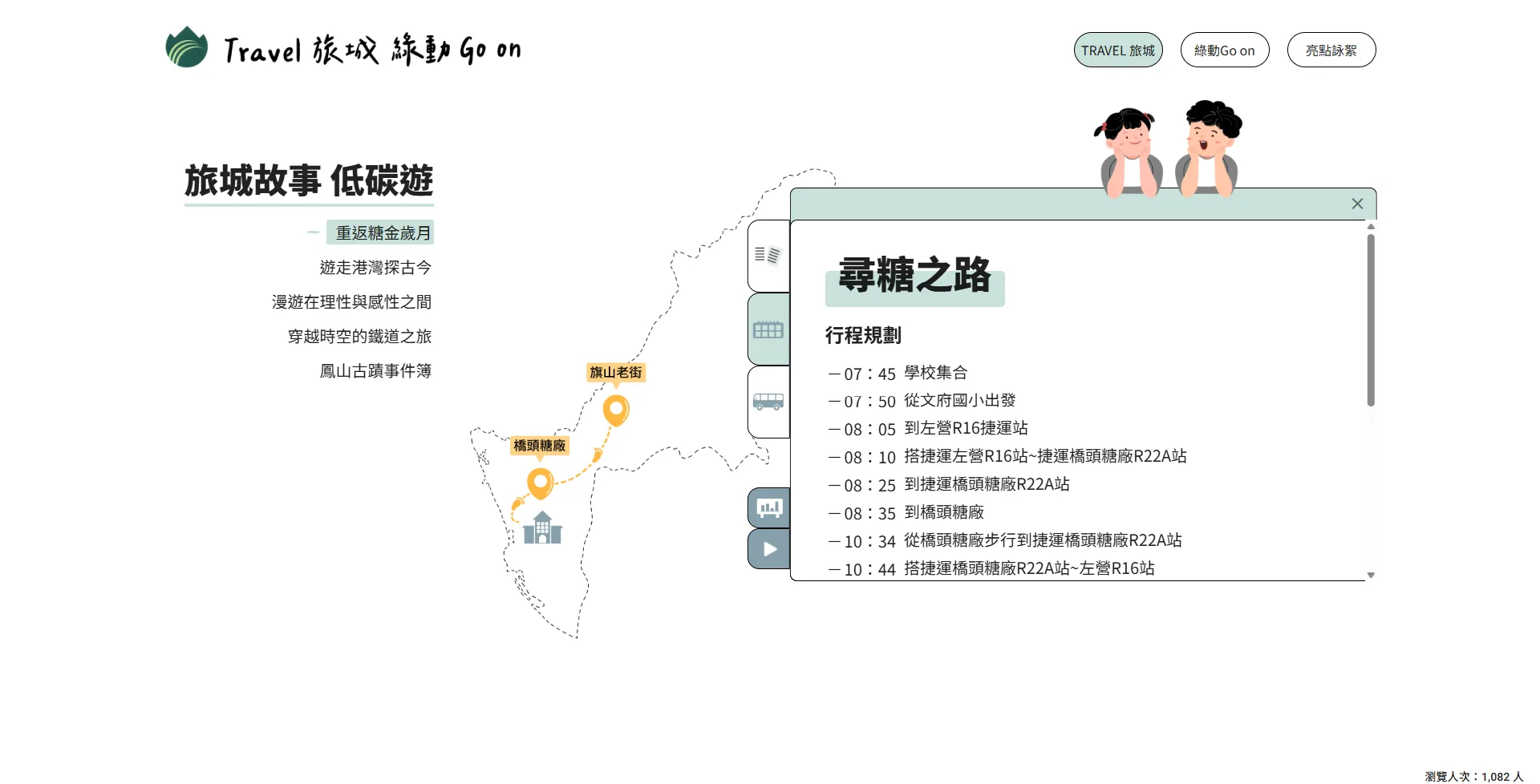
- Return to the Sugar-Gold Years: centered on Ciaotou Sugar Refinery and Cishan Old Street — the trip departs from school by MRT to Ciaotou Sugar Refinery, then continues on foot back to the station, tracing the region’s old sugar-industry history from start to finish
- Exploring the Harbor, Past and Present: a tour of the port culture around Hamasen and Gushan
- Wandering Between Reason and Feeling: a travel experience blending knowledge with human, cultural sentiment
- A Railway Journey Through Time: a rail-focused itinerary connecting the TRA, MRT, and light rail
- The Fengshan Heritage Files: a historical tour centered on Fengshan’s local heritage sites
Each route is presented through a lively tabbed layout, bringing together student-shot photos, embedded YouTube videos, attraction descriptions, and detailed itineraries — so visitors don’t just see “where to go,” but get a feel for what the kids who planned the route wanted to say. Take “Return to the Sugar-Gold Years” as an example: the itinerary starts at 07:45 with everyone meeting at school, runs entirely on public transit, and even the transfer times and station names along the way are fully noted.
Image source: 5A TRAVEL 旅城‧綠動Go on
A bilingual map of plastic-reduction-friendly businesses
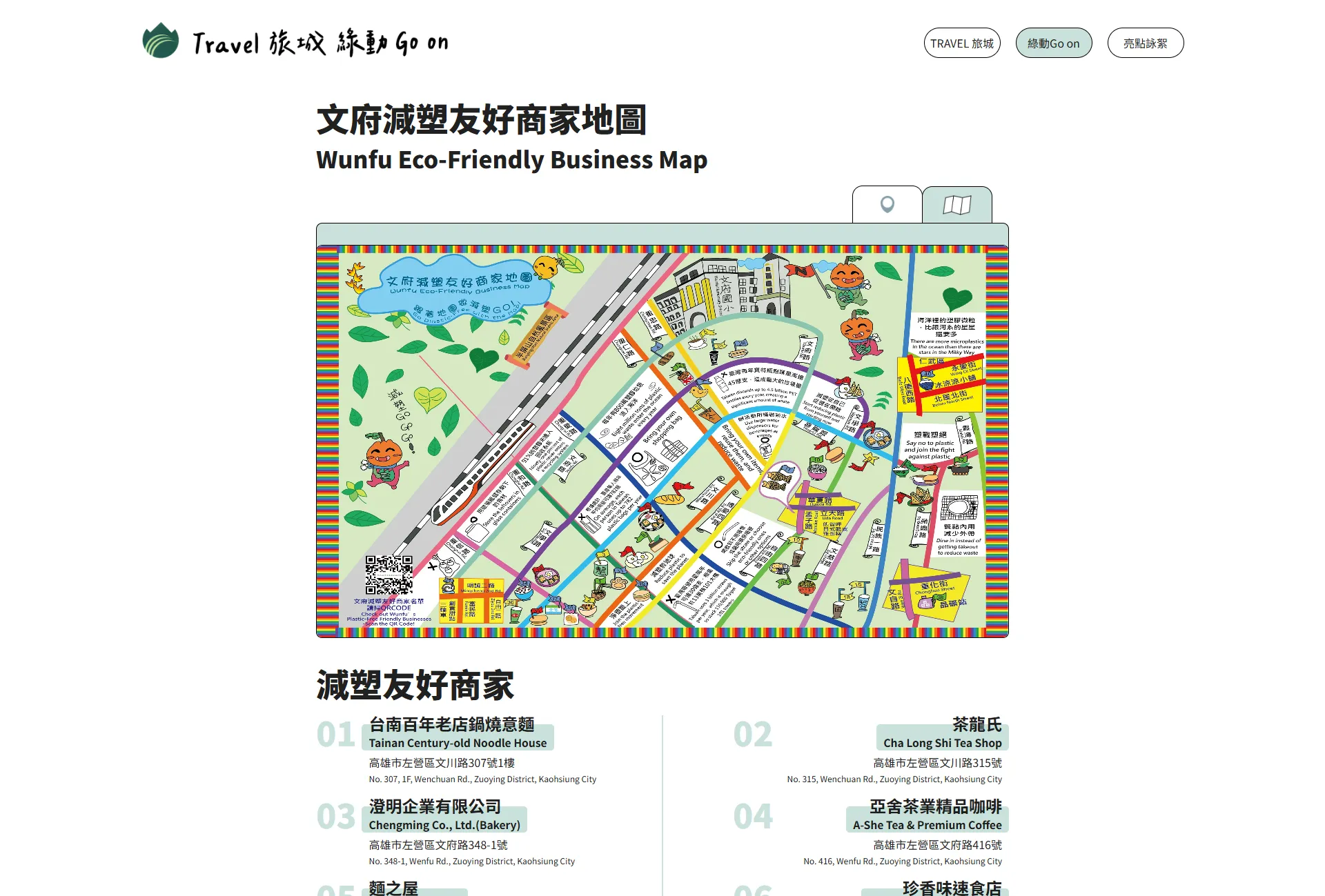
Beyond route guides, the site’s other core feature is the Wunfu bilingual map of plastic-reduction-friendly businesses.
This list exists because students went into the community themselves — visiting shops and persuading business owners to join. From first noticing the community’s plastic-bag problem, to holding briefing sessions, drawing the map, and actively taking part in exhibitions, this map represents an entire grade level’s record of action.
The site presents business information in both Chinese and English, currently listing 38 local plastic-reduction-friendly businesses around Zuoying, Nanzih, and Renwu — everything from noodle shops and drink stands to brunch spots and convenience stores — making it easy for international visitors and partner schools to find their way around. Business data is updated over time, and visitors can toggle between the students’ hand-drawn map and Google Maps.
Image source: 5A TRAVEL 旅城‧綠動Go on
Challenges along the way
Bringing diverse outputs into one unified presentation
The students’ coursework came in a huge range of formats: route-planning documents, video records, business-visit reports, event photos. Figuring out how to integrate all these different formats into one cleanly structured website took up the most discussion time during the design phase.
In the end, we used the route detail page as the primary container, letting each route carry text, images, and video together — flexible enough to hold everything, while keeping the overall visual presentation consistent.
Bilingual content and long-term maintenance
The site’s audience includes Wunfu Elementary’s international partner schools, which made bilingual presentation a requirement, not a nice-to-have.
Long-term maintenance of the business map was also part of the design: friendly-business information changes over time — new businesses join, old ones may close — so the school needed a data-management workflow it could use to keep things updated.
A visual style that’s playful, but still polished
Students are the stars of this platform, but visitors also include parents, educators, and international exchange partners. The visual design had to strike a balance between the “vitality of student work” and the “professional feel of a public-facing site.” Estab-Zenith invested in custom illustrations and an overall color scheme for the site’s web components, giving the site a look that represents the Wunfu Elementary brand.
Core technology
- Front-end framework: Vue.js + Nuxt.js + Vuetify
- Development languages: HTML5, CSS3, JavaScript (Node.js packages)
- Responsive design: RWD, supporting every device screen size
- Deployment environment: Google Cloud Platform server in Taiwan (2 vCPU + 8GB RAM)
- Design scope: UI/UX planning, key visual design, site color scheme, web component illustrations
Staying alongside them for the long run
Wunfu Elementary’s plastic-reduction education isn’t a project with an end date — and neither is the website.
After launch, Estab-Zenith continued providing annual operations services, helping update the site year after year — for example, building out the full plastic-reduction-friendly business dataset, and re-integrating the bilingual business list back into the map as new features.
The core lesson from this project
This website exists so that a group of kids who took their work seriously would have a digital stage worthy of their effort.
There was no particularly difficult technical decision here — but making the site truly “worthy” of what these students did required carefully understanding what they did, and why they did it.
“Nothing changes if you don’t act — but everything changes when you do.” That was the theme of the students’ plastic-free graduation trip, and it’s also our best description of this project.
Related Case Studies
Education & Social Impact
Anti-Wandering System: Bluetooth Tracking and LINE Location Lookup for Seniors with Dementia
Estab-Zenith's patented Identity Recognition and Network-Based Location Joint Notification System, showcased through Chiayi City's 'Chiayi Guardian' program. This anti-wandering device and information system integrates BLE tags, a mobile app, a multi-function LINE Official Account rich menu, and a citywide network of checkpoint scanners to build a city-wide walking safety net.
Education & Social Impact
新北幼幼歡樂多語影音秀: A Platform for Registration, Video Showcase, and Online Voting
Built for six consecutive years for the Education Department, New Taipei City Government, this annual event platform for 新北幼幼歡樂多語影音秀 brings together online registration, entry showcases, online voting, and a real-name verification system that prevents duplicate voting — letting the multilingual creations of preschool teachers and children across the city reach a much wider audience through a digital platform.
You can get results like this too!
Start with AI requirement analysis and turn your idea into a concrete requirements draft.
Start My AI Analysis