Healthergo (PT Official Website): A Personal Branding Website for a Physical Therapist
Physical therapist Jane doesn't just provide physical therapy — she also works as a corporate coach and mentor to fellow practitioners. Her official brand site needed to bring together visual identity, service flow, and a blog to present the trustworthy side of Healthergo.
Flexible development
Client involved throughout development, with new features added along the way
Self-maintained
Content updates require no engineer
One-time self-hosted setup
No monthly fee and transparent domain costs
Requirements
Healthergo focuses on workplace health, offering on-site consulting, musculoskeletal health seminars, ergonomic hazard identification, and maternal health protection services. Before coming to Estab-Zenith, Jane already had her own blog site — this project meant not just building a brand website, but migrating her existing articles to the new site and making it easy for a non-technical founder to maintain herself.
- Corporate HR staff had a hard time finding or evaluating the service, and business growth relied on word of mouth
- The range of services was broad and the experience flow had real complexity, which needed to be presented clearly on the site without losing visitors along the way
- The site's content had to be maintainable by a non-technical client, so the development approach had to prioritize ease of use from the start
Let's Solve It!
- Built the site on self-hosted WordPress.org, so the client can update articles and service content herself going forward without relying on an engineer
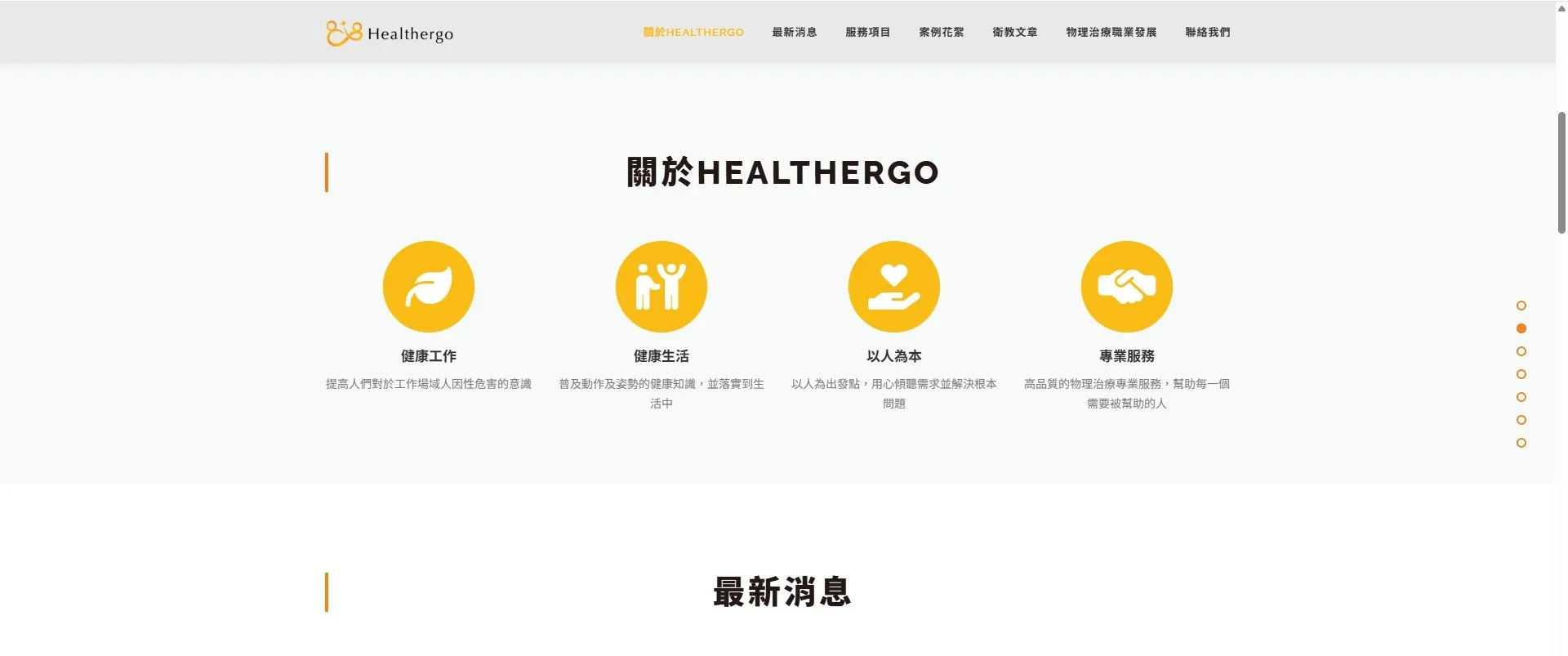
- Integrated the client's brand logo and on-site service photos, with a clear page structure and banner visuals for each service
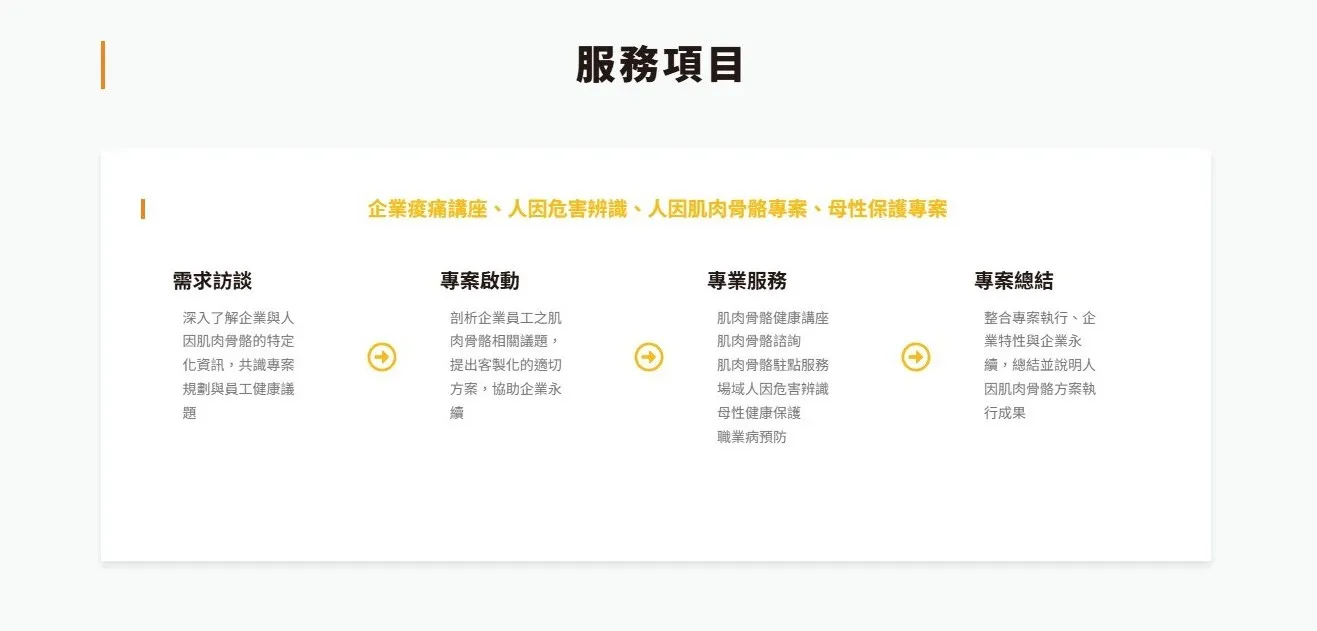
- Visualized the workplace experience service flow (interview → service delivery → results report → program rollout) so prospective clients can grasp it at a glance
- Delivered a complete operating guide after launch to help the client manage content independently, and set up daily automated backups
Case Details
Putting physical therapy expertise online
Image source: Healthergo official website
What Jane does isn’t common in Taiwan, and it matters.
Healthergo provides workplace musculoskeletal health services — health seminars, consulting sessions, on-site programs, and the results reports and program rollouts that follow. Her clients are companies, and her point of contact is usually HR or a workplace safety manager. This kind of service has a particular dynamic: clients need to understand and trust the offering first, before any engagement follows.
These days, a website functions like a digital business card — not just for everyday consumers, but for corporate HR staff, all kinds of institutional contacts, and now even AI crawlers. So how a site “looks” isn’t just about aesthetics — it needs rich functionality and readability to stand out in a sea of data.
Making the service visible, and the process clear
The key to building a brand site is helping visitors understand, in the shortest time possible, what this company can do for them.
Healthergo’s service isn’t a single touchpoint — it’s a process. For a company, the journey from “realizing there’s a musculoskeletal problem in the workplace” to “rolling out a complete program” runs through a needs interview, an experience session, a results report, and a follow-up interview before a formal program begins. This flow is second nature to insiders, but without clear visual guidance, outside visitors can easily get lost.
Visualizing this service path lets HR staff open the page and immediately understand how Healthergo’s service unfolds, and what happens at each stage.
For how the service offerings themselves should be presented, the client had a clear idea from the start: a banner-style layout, with the core services lined up side by side so visitors can scan them all at a glance. That instinct was right — decision-makers evaluating workplace services tend to compare quickly, and a banner layout suits that better than a list.
Image source: Healthergo official website
“.org” vs “.com” — both WordPress, but worlds apart
A lot of people hear “WordPress” and assume “.org” and “.com” are the same thing, just different URLs. In reality, they’re two completely different service models: WordPress.com is an officially managed plan, where your site runs on someone else’s servers — simple to operate, but limited in customization. WordPress.org is open-source software — you choose your own server, plugins, and themes, but that also means you’re responsible for how the site runs and who maintains it. Healthergo was the right fit for the latter.
When we chose the development approach, there was really only one core consideration: the client has to be able to maintain this site herself.
Healthergo’s core team is physical therapists, not engineers. If updating a service article or swapping out a photo meant contacting an engineer every single time, the site’s maintenance cost would quickly turn it into a static page no one bothers to update anymore.
For everyday tasks like swapping images or publishing an article, she can do it herself. When she wants finer adjustments to the site’s display, a specialized tech company is available on a credit-based hourly rate — an hour or two, a few thousand NT dollars, whenever the need arises. Why hire a full-time engineer for that?
WordPress’s admin dashboard is friendly to non-technical users, and that requirement drove the technology choice. The self-hosting flexibility of .org also let us use custom CSS to give the site more visual personality.
After launch, we delivered a complete operating guide and set up a LINE consulting channel, so the client can manage content herself without needing outside help every time.
The site is deployed on a Google Cloud Platform (GCP) server in Taiwan. Shortly after launch, the client also commissioned a daily automated backup mechanism, regularly saving site data to GCP Storage. These costs remain fully transparent — Estab-Zenith only assisted with the one-time setup.
Related links
Jane, Physical Therapist
Technical architecture
Official website
- Platform: WordPress
- Deployment: Google Cloud Platform (GCP) server in Taiwan
- Backup: Daily automated backups to GCP Storage
The core lesson from this project
How do professional expertise and market visibility connect? What Healthergo’s physical therapist does has real value — and a good official site makes that value visible to the outside world. Sometimes going digital isn’t about optimizing a process — it’s the most basic thing of all: letting people find you.
Technology choices should align with the client’s day-to-day capabilities, not the engineer’s habits. WordPress isn’t the trendiest choice, but it’s the practical one that lets a non-technical client genuinely maintain her own site. A good system is one the client can actually use — not one that requires calling an engineer every time.
Related Case Studies
Enterprise Systems
Decathlon Sports Club: A Global Platform Connecting Three User Groups
A nationwide sports experience registration platform built for Decathlon Taiwan, integrated with the brand's global membership and payment systems. It unifies internal staff, partner coaches, and members into one platform — covering discovery, registration, and venue booking end to end — backed by a long-term operations model.
Enterprise Systems
INEN E-Bike Travel Official Website: Self-Service Blog Management and Cloud Infrastructure
Built a WordPress official blog for the INEN e-bike rental and travel app, providing web brand design, cloud infrastructure, and data redundancy — a complete official-site foundation that stays reliable from content publishing to day-to-day operations.
Enterprise Systems
JenYuh Chemical Corporate Website: Digital Branding for Traditional Manufacturing
JenYuh has deep roots in manufacturing. Estab-Zenith has supported them with a full-service, side-by-side partnership — from trade-show video walls, posters, and business cards to official site development and GCP cloud infrastructure — handling both offline visuals and online systems to build JenYuh's complete digital brand identity.
You can get results like this too!
Start with AI requirement analysis and turn your idea into a concrete requirements draft.
Start My AI Analysis